
Pario: Chat, Meet & Dating App
EDREAMS LIMITEDSocial
4.47.78K Reviews
- Version
- 1.4.9
- Installs
- 500.00K
- Age Rating
- Mature 17+
Screenshots







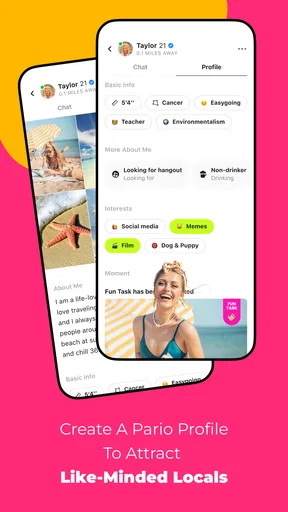
Our Review of Pario: Chat, Meet & Dating App
 Analysis by Appyee
I approached Pario: Chat, Meet & Dating App as a social app for adults who want to meet people and begin conversations nearby, but its household context deserves more attention than the short store wording suggests. A dating service is rarely used in isolation: phones are shared, tablets are left unlocked, notifications appear at awkward moments, and people sometimes help relatives with app setup. Those everyday details can affect whether Pario feels comfortable as much as its chat experience does.
My overall impression is that Pario is best treated as a personal dating space, not as a general-purpose social app for everyone in the home. It is free to install, belongs to the Social category, and is published by EDREAMS LIMITED. The app has built a 4.4 average from around 57 thousand ratings, with more than 500 thousand installs, which suggests that it has attracted a meaningful audience without making it feel like a universal replacement for every established dating service.
How Pario fits into real household use
The most realistic shared-device situation is simple: one person owns a phone, but a partner, sibling, parent, or child occasionally borrows it. In that setting, opening a dating app is not automatically a problem, yet an unexpected profile, chat preview, or notification can reveal more than the user intended. I would therefore keep Pario on my own device whenever possible and avoid treating a shared tablet as a neutral place for private conversations.
This is not a criticism of the matching idea itself. It is a reminder that dating conversations contain personal information from the first message onward. Even a harmless greeting can become uncomfortable if another household member sees it without context. I found that the practical question is not only “Can I use the app?” but also “Who can see the screen when I am using it, and who might pick up the device later?”
Pario makes the most sense for someone who wants a focused way to meet nearby singles and start chats without turning a broader social network into a dating space. That distinction matters. General social platforms mix friends, relatives, colleagues, public posts, and private messages. Pario is more purpose-built around meeting potential dates, so the user’s intention is clearer. The trade-off is that the content is more sensitive in a household where devices or accounts are not strictly separated.
Keeping the account boundary clear
When I think about setting up Pario on a device used by more than one person, I would begin with account boundaries rather than profile decoration. The person using the app should have their own device access, their own login details, and a clear understanding that the profile represents them. I would not create a profile for a relative while casually switching between accounts, because a dating profile needs accurate identity and consistent conversation history.
That advice is especially important when someone asks for help because they are less comfortable with smartphones. Helping with installation is reasonable; choosing photos, writing messages, or speaking to matches on another person’s behalf crosses into a different area. The app can only work honestly when the person represented by the profile is the person making the decisions. I would explain each screen, then hand control back to the account owner.
I also recommend checking the screen before handing a phone to someone else. This is a small habit, but it prevents accidental exposure better than assuming everyone understands what the app contains. Close the conversation you were reading, return to a neutral screen, and think about notifications that may appear while the device is unattended. I am not presenting these as special Pario controls; they are sensible boundaries for using any dating app on a shared device.
Another useful boundary is separating household coordination from dating conversations. If I need to tell someone at home that I will be late, I would use the usual family or messaging channel rather than mixing that task with Pario. Keeping the app’s purpose narrow makes it easier to know which conversations are private, which are logistical, and which should never be sent from the dating profile.
Using Pario without confusing coordination and privacy
A dating app can create small coordination problems that are easy to overlook. Someone may ask to borrow the phone just as a new message arrives. A household member may see that the app is open and assume the user is available to talk. A person may also forget which account is active after helping someone else with setup. I would handle these situations by making one rule explicit: the account owner decides when the app is used, and household convenience does not override that boundary.
For couples or housemates who share schedules, it is tempting to explain every notification or match immediately. That is not always helpful. Coordination should cover practical matters such as device access, charging, or travel plans, not require a person to disclose the content of private chats. In my view, trust is stronger when people agree on device etiquette without demanding access to each other’s dating conversations.
There is also a useful everyday scenario for people living with family. Imagine someone who works late, returns home, and wants to answer a conversation while sitting in the kitchen. The sensible workflow is to choose a private moment, check that the phone is not being passed around, and avoid leaving the app visible when stepping away. This takes only a few seconds, but it makes the experience less stressful than trying to explain a personal chat after someone has already read part of it.
Pario is also not the right coordination tool for a group. If several people want to arrange an outing, compare times, or share a location, a normal messaging app is clearer. Pario’s value is the one-to-one discovery and conversation context. Using it for household planning would make the app feel confusing and could send the wrong signal to people on the other side of a match.
Age context changes the recommendation
The age rating is Mature 17+, so I would not treat Pario as a family-friendly app that can be casually placed on a child’s shared tablet. The rating is a practical warning about audience and subject matter, not merely a label to ignore during installation. In a home with teenagers, I would keep the app and its conversations separate from devices they regularly use, and I would discuss why dating spaces require stronger privacy awareness than ordinary social feeds.
For adults, the age context still matters. Being old enough to use the app does not remove the need to be careful with personal details, meeting plans, or pressure from a new contact. I would avoid sharing a home address early, keep first meetings in public places, and tell a trusted person where I am going. These are not app features, and Pario should not be mistaken for a substitute for judgment. The app can help start contact; it cannot establish that a stranger is trustworthy.
I would also be cautious about using the service on a device that a minor can unlock. Even if the account belongs to an adult, profiles and conversations may appear at the wrong time. A household with mixed ages needs a clear separation between adult dating use and family entertainment or school use. If that separation is impossible, I would skip installing Pario on the shared device and use a personal one instead.
Trust works in both directions. A person using Pario should be honest about who they are, while a household member offering technical help should respect the account owner’s privacy. Looking over someone’s shoulder, reading messages without permission, or taking control of a profile can damage trust quickly. I prefer a setup where assistance is transparent and limited: help with the device, not with the person’s romantic decisions.
What the app experience is good at
Pario’s strongest appeal is its narrow purpose. I can see why someone would choose it when they want to meet nearby singles and begin a conversation in a space designed around that intention. The experience is easier to understand than a general social network where dating is only one possible activity. If I were introducing a friend to it, I would describe it as a direct starting point for social discovery, not as a guarantee of meaningful matches.
The free entry point lowers the barrier to trying it. That is useful for someone who wants to see whether the local conversation pool suits them before committing money. At the same time, in-app purchases range from less than a dollar to nearly five hundred dollars per item, so I would pay attention before confirming any optional purchase. A free installation does not mean every part of the experience is free, and the very wide purchase range is a reason to slow down rather than tap through quickly.
My practical tip is to decide in advance what I am willing to spend, if anything, and to treat every paid option as a separate decision. I would not buy something simply because a conversation feels exciting or because I want faster results. Dating apps can make users impatient, especially when they are hoping for a reply. A pause before purchasing helps keep the app in perspective.
Pario runs on Android devices using version 7.1 or later, which makes it accessible to people with older compatible phones. The current version is 1.4.9. For a shared household device, I would still consider whether the phone receives security updates and whether its lock screen is reliable. Compatibility tells me the app can run on an older operating system; it does not make an outdated or widely shared device ideal for sensitive conversations.
Where it differs from familiar alternatives
Compared with a general social network, Pario offers a clearer dating purpose and less reason to mix romantic discovery with family or work contacts. That focus can make the first step less awkward. The downside is that a general platform may be more familiar to people who already have established communities there, while Pario asks the user to build a new social context around dating.
Compared with larger, more established dating services, Pario may appeal to someone who prefers a simpler, more focused place to start. However, I would not assume that a smaller install footprint automatically means a better local selection, safer conversations, or more compatible people. The right choice depends on who is active in the user’s area and how comfortable they are with the app’s style. If a friend already has meaningful conversations elsewhere, moving simply because Pario is newer would not necessarily improve their experience.
Pario is also different from anonymous chat apps. Its dating framing gives conversations a clearer purpose, while anonymous spaces can encourage casual exchanges with fewer expectations. I prefer Pario for someone who wants to be open about looking for dates, but I would recommend a different type of social app to anyone who mainly wants public discussion, hobby groups, or low-stakes conversation.
Small habits that make the experience better
My first habit would be writing a profile that sets expectations without revealing too much. I would mention the kind of conversation I enjoy and the sort of connection I am open to, but I would leave out details that identify my home, daily route, or workplace too precisely. This gives a match something real to respond to while preserving room to build trust gradually.
My second habit would be treating the first few messages as a screening stage rather than an obligation. A fast reply does not create a duty to continue. If someone ignores a clear boundary, demands personal information, or pushes to meet before I am comfortable, I would end the exchange. The practical strength of a dating app is choice; it becomes less useful when the user feels trapped by politeness.
My third habit would be planning a transition from chat to meeting carefully. I would suggest a public location, arrange my own transport, and tell someone I trust the basic plan. I would not invite a new match directly to the home, and I would not use household routines as a reason to reveal when nobody else is present. A good conversation should survive a cautious approach.
Finally, I would review the app’s purchase prompts with the same patience I use for messages. The low end of the purchase range may look harmless, but repeated small decisions can still add up, while the upper end deserves particular care. If another person uses the device for app-store purchases, I would make sure the account boundary is clear so that a household member cannot accidentally approve something intended for someone else.
Who should try it, and who should skip it
I think Pario is a reasonable choice for an adult who wants a dedicated place to meet nearby singles, prefers a direct social purpose, and can keep the account on a personal device. It is especially suitable for someone willing to begin with conversation, judge people gradually, and accept that not every match will become a date. The free installation makes experimentation straightforward, provided the user watches optional spending.
I would skip it for anyone looking for a children’s or family social app, anyone who needs a group-planning tool, or anyone who cannot maintain a private account boundary. I would also hesitate if the person expects the app alone to solve loneliness, guarantee compatible dates, or verify every stranger. Those expectations are too heavy for a chat-and-dating service.
People who already have a thriving community on another dating platform may not gain much by switching. Likewise, someone who wants professional networking, interest-based clubs, or broad public conversation would probably be better served elsewhere. Pario’s focused purpose is its advantage, but that same focus limits its usefulness outside dating.
My household verdict
After considering both the social experience and the way it fits into a home, I see Pario as a focused adult dating app that can work well when the user keeps control of the account, the device, and the pace of each conversation. Its 4.4 average and audience of over 500 thousand installs show that it has found real interest, but those figures do not replace personal judgment about local activity or privacy.
I would recommend it to a friend who wants to try a dedicated dating space and has a personal phone or clearly separated user access. I would not recommend installing it casually on a family tablet, leaving it open around children, or treating it as a shared household service. The best Pario setup is personal, deliberate, and private.
In the end, Pario: Chat, Meet & Dating App is most convincing when used for what it is: a starting point for meeting adults and opening conversations. Keep expectations realistic, be careful with purchases, protect the account boundary, and move from chat to real-world meetings slowly. With those habits, it is worth trying; without them, a different social arrangement—or no dating app on a shared device—would be the wiser choice.
Verdict
Strengths of Pario: Chat, Meet & Dating App
- Simple interface makes browsing profiles quick and easy.
- Multiple ways to discover people with similar interests.
- Chat features encourage direct conversations after matching.
- Useful for meeting people beyond your immediate social circle.
- Profile-based discovery helps users find compatible connections.
Limitations of Pario: Chat, Meet & Dating App
- The quality of matches may vary by location and user activity.
- Some features may require an in-app purchase or subscription.
- Dating apps can involve inactive, incomplete, or misleading profiles.
- New users may need time to build a useful network of matches.
- Privacy settings should be reviewed carefully before sharing personal details.
Similar Picks in This Category
View All
Meta Platforms, Inc.4.6

Instagram4.0

Likee-Live, Chat & Party Games
Likeme Pte. Ltd.4.4

Facebook Lite
Meta Platforms, Inc.4.5

TikTok - Videos, Shop & LIVE
TikTok Pte. Ltd.4.0

Moj: Free Short Drama & Reels
ShareChat4.1
Frequently Asked Questions
What is Pario: Chat, Meet & Dating App used for?
Pario is designed for meeting and communicating with new people through chat and dating-oriented features. After creating a profile, users can generally present their interests, discover other members, and start conversations when there is mutual interest. The app may be useful for casual chatting, friendship, or romantic connections, but the experience depends on the activity and quality of users available in your location.
Is Pario free to download and use?
Pario can typically be downloaded without an upfront charge, although some features may be limited to free members. Dating apps often place advanced discovery tools, increased visibility, unlimited interactions, or other extras behind optional purchases or subscriptions. Before confirming any payment, review the current pricing, renewal terms, and cancellation instructions shown in the app, since available plans and features can change by country or platform.
How does matching and messaging work in Pario?
The app usually allows you to browse or discover profiles and decide which people interest you. Depending on the available version, messaging may require a mutual match, an invitation, or access to a specific feature. Once a conversation begins, users can chat inside the app. Keep your profile honest and respectful, and remember that not every profile is necessarily active, genuine, or compatible with your expectations.
Is Pario safe for meeting people online?
Pario may provide reporting, blocking, privacy, or profile-management tools, but no dating platform can guarantee that every member is trustworthy. Avoid sharing your home address, financial information, passwords, identity documents, or private images with strangers. Be cautious of requests for money and suspicious links. If you arrange an in-person meeting, choose a public location, tell someone you trust, and maintain your own transportation.
What should I check before downloading and creating a Pario account?
Before signing up, check whether Pario is available in your country, what permissions it requests, and whether its privacy policy explains how profile details, photos, messages, and location data are handled. Confirm the minimum age requirement and review subscription conditions if premium services are offered. Also consider whether the app has enough active users near you, as local availability strongly affects the overall dating experience.
